AI note-taking app: the 6 best in 2026 — pick by what you're actually taking notes on

"AI note-taking" is two different categories wearing one label: tools that listen to meetings, and tools that hold your thinking. Buy the wrong kind and you'll blame yourself for not using it. Here's the split, and the best of each.

First question: meetings, or your own head?

Meeting note-takers

Granola, Otter, Fireflies. They join or listen to calls, transcribe, summarize, and extract action items. Input: other people talking. Output: a record. If your calendar is wall-to-wall calls, start here.

Thinking tools

Notion AI, Obsidian, Mem, Postal. They hold ideas, research, decisions, and reading notes — and use AI to organize, connect, and retrieve them. Input: your own stream of thought. Output: a mind you can query. If your problem is "I know I wrote this down somewhere," start here.

The four capabilities that separate good from gimmick, in either category: capture without friction, organization without your help, retrieval by meaning rather than keywords, and — rarest — action: the note becomes a task, a calendar event, or a research request instead of a fossil.

The picks

1. Postal — best for notes that become action

Thinking tool

Ours — judge the claims, not the byline. Postal treats a note as the start of something: brain-dump by voice (a local Whisper model — audio never leaves your device) and the AI splits it into separate labeled items; ask a question and semantic search answers from your own notes; say "look into this" and background research writes the note for you; a note can carry a due date or land on Google Calendar. Notes are Markdown files on disk, so they're greppable, git-able, and writable by your coding agents.

Pricing: free forever with your own key; optional managed AI later if you want it.
Skip it if: you need meeting transcription (pair it with Granola) or team wikis.

2. Granola — best for meeting notes

Meetings

The current favorite among founders and VCs: it listens to the call while you jot fragments, then merges your half-notes with the transcript into something coherent. No awkward bot joining the meeting. Skip it if most of your notes aren't meetings — it has no life outside them.

3. Otter.ai — best for full transcription

Meetings

The transcription workhorse: real-time transcripts, speaker identification, searchable archives of everything said. Built for volume — lectures, interviews, all-day call schedules. Skip it if you want synthesis over stenography.

4. Notion AI — best for team knowledge bases

Thinking tool

If your company already lives in Notion, its AI answers questions across your whole workspace and drafts documents in place. The best "chat with our wiki" experience. Skip it if you want a fast personal tool — Notion's weight shows when it's just you and a thought moving at speaking speed.

5. Obsidian + AI plugins — best for tinkerers who own their files

Thinking tool

Markdown files in a local vault, a huge plugin ecosystem, and community AI plugins for chat-with-vault and semantic search. Maximum control, maximum ownership. Skip it if you don't want to be your own IT department — the AI layer is assembled, not included. (Want files-you-own with the assembly done? That's the architecture Postal ships.)

6. Mem — best for automatic organization

Thinking tool

Mem's bet is "stop organizing entirely": write, and let AI surface related notes when they matter. When it clicks, it feels like magic. Skip it if you want structure you can see, files you can hold, or tasks that leave the app.
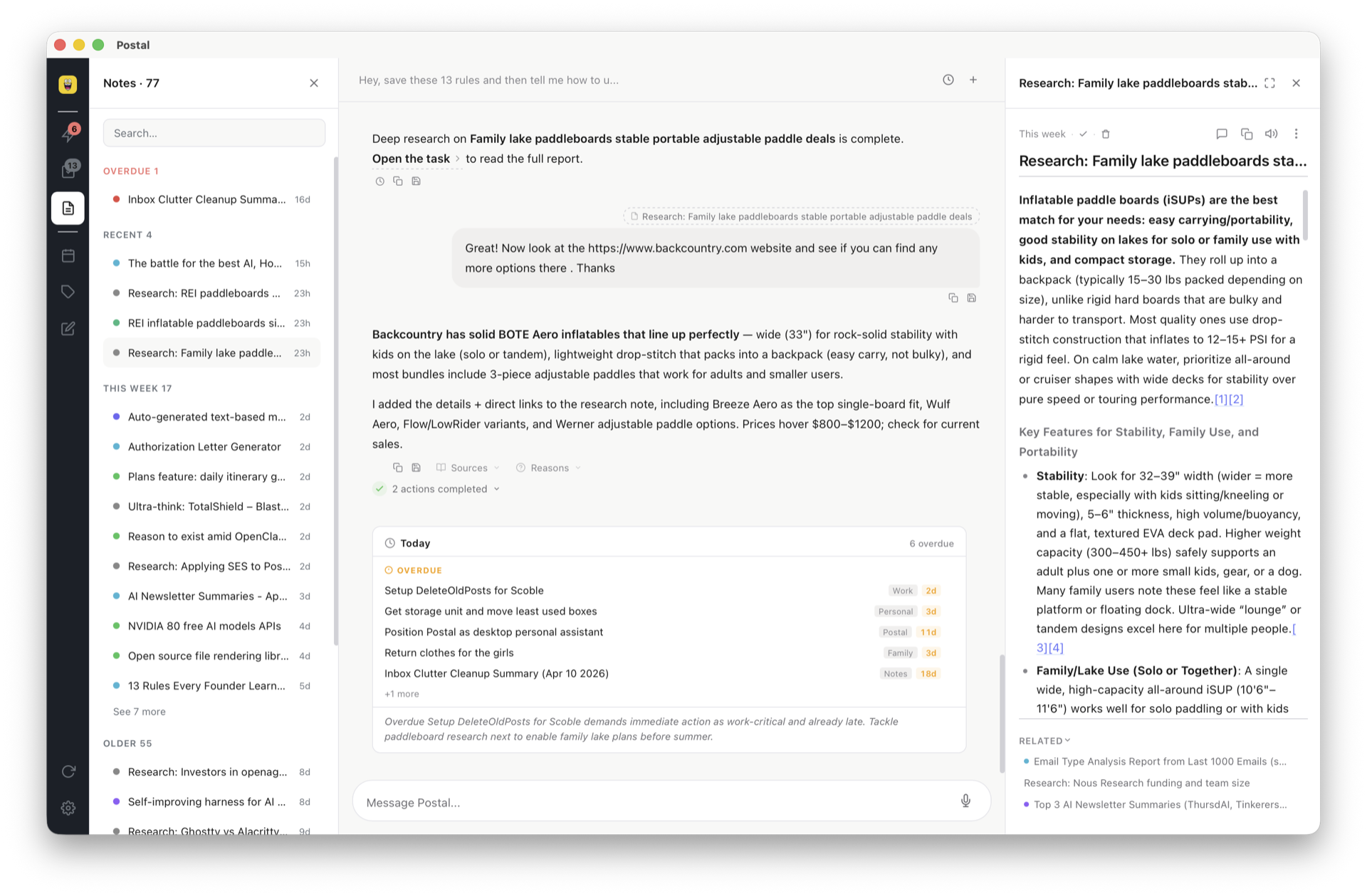
Postal turning a voice brain dump into three labeled items: a note, a task with a due date, and a research request, shown in the confirm dialog

Frequently asked questions

What is the best AI note-taking app?

Decide which problem you have first. Meetings: Granola or Otter. Your own thinking: Notion AI for teams, Obsidian + plugins for file-owning tinkerers, Postal for notes that turn into tasks, research, and calendar events instead of sitting in an archive.

What should an AI note app actually do?

Capture without friction, organize without your help, retrieve by meaning, and act on what's in the note. Most apps stop at summarizing — the last one is the differentiator.

Is there an AI note app that keeps notes in plain files?

Obsidian, and Postal. Postal stores every note as Markdown with JSON metadata — open them in any editor, grep them, version-control them — while the app adds semantic search and AI organization on top.

Can AI note apps do voice notes?

Postal uses a local Whisper model for dictation — your voice never leaves the device — then splits the ramble into separate labeled items you confirm. Meeting transcribers handle voice too, but they're tuned for other people talking.

Do AI notes replace a task manager?

Only if tasks are first-class. The failure mode of every notes app is action items dying in the archive. In Postal a note can carry a due date, become a task, or land on the calendar — one workspace, no copying. See also: the AI task manager guide.

Notes that don't just sit there

Capture by voice, organized by AI, stored as Markdown you own — and one step from becoming a task, an event, or finished research.

Get started free